

Durasleeve Plate Dowels: The Silent Hero of Load Transfer Between Slabs
A plate dowel is load-transfer hardware installed at a concrete joint that allows the two slabs to move independently in the horizontal plane (to accommodate shrinkage and thermal movement) while staying locked together in the vertical plane (so wheel loads don’t cause one side of the joint to deflect more than the other). Without it, joints develop lipping, edge spalling, and rack misalignment — usually within a few years of high-traffic use.
Nobody notices a joint working correctly. They notice one that isn’t — a slight lip where a forklift wheel bumps as it crosses, a rack leg that’s ever so slightly out of level because the slab under one of its feet has settled relative to its neighbour. Almost always, the root cause is the same: two slabs on either side of a joint that are no longer moving as one.
That’s the exact problem plate dowels are designed to solve, and it’s a problem that’s invisible right up until it isn’t.
What is a plate dowel?
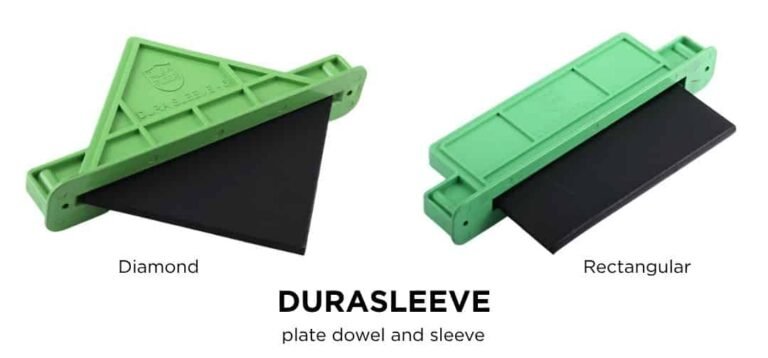
A plate dowel is a flat steel plate, sleeved on one side, cast into a concrete joint to transfer vertical wheel loads evenly between two adjacent slabs while still permitting the horizontal movement concrete needs as it cures and responds to temperature change. Durasleeve is Durafloor’s plate dowel and sleeve system, designed specifically for high-traffic industrial floor joints.
What a joint actually has to do
Every construction and contraction joint in an industrial floor has two, slightly opposed jobs:
- Allow horizontal movement. Concrete needs to contract and expand slightly as it cures and as temperature changes. Forcing that movement to zero just relocates the stress into a crack somewhere else.
- Prevent vertical movement. If one side of a joint can deflect independently of the other under a wheel load, you get differential movement — lipping, edge spalling, and uneven load transfer to anything nearby, including racking.
Reconciling those two requirements — free horizontal movement, locked vertical alignment — is what load transfer hardware exists to do.
Round dowel vs. plate dowel: how they compare
| Factor | Round Dowel Bar | Plate Dowel (Durasleeve) |
|---|---|---|
| Load transfer mechanism | Round bar in matching round sleeve | Flat plate in matching flat sleeve |
| Bearing area | Smaller, point-contact | Larger, distributed contact |
| Resistance to joint rotation | Moderate — can allow slight rotation under repeated heavy loads | Higher — flat profile resists rotational movement more effectively |
| Best suited for | General industrial traffic | High-frequency wheel traffic (VNA aisles, dock approaches) |
| Horizontal movement tolerance | Good | Good — sleeve engineered to allow free sliding |
| Long-term joint performance under heavy MHE traffic | Can develop lipping over time | Designed to resist lipping under sustained heavy traffic |
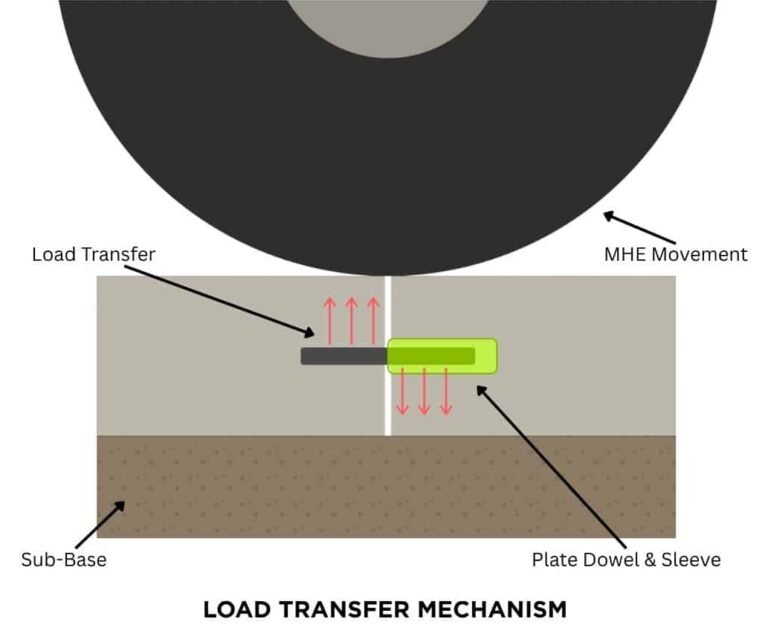
How a plate dowel does this
It resists rotation, not just vertical shear. A round dowel transfers vertical load well but can allow some rotational movement at the joint under repeated heavy wheel loads over time. A flat plate’s greater bearing area and profile resist that rotational tendency more effectively — which matters directly in high-traffic areas like dock approaches and VNA aisle crossings, where the same joint gets hit by the same wheel path thousands of times.
It tolerates the horizontal movement it’s supposed to allow, more cleanly. The sleeve is designed to let the plate slide freely as the slab expands and contracts, so the joint isn’t fighting itself — locked enough vertically to transfer load evenly, free enough horizontally to avoid restraint stress that would otherwise crack the slab near the joint.
Where this matters most
Load transfer hardware matters at every construction joint, but its importance scales sharply with a few conditions:
- High-frequency wheel traffic, where the same joint sees thousands of load cycles rather than occasional pedestrian or light traffic
- Heavy point loads, particularly under VNA or high-bay racking systems, where uneven joint behaviour translates into rack misalignment at height (see our VNA floor design checklist)
- Large-panel or jointless-adjacent designs, where the few joints that do exist are doing proportionally more work, because there are fewer of them sharing the load-transfer duty across the floor
- Facilities where downtime for joint repair is expensive — a properly load-transferred joint very rarely needs the reactive repair that an unreinforced or poorly aligned round-dowel joint eventually does
What happens when it’s skipped or done poorly
Joints without adequate, correctly aligned load transfer hardware are one of the most common sources of the “step” or “lip” defects that show up at industrial floor joints within a few years of commissioning. Once that differential deflection starts, it’s largely self-reinforcing — the lip itself becomes an impact point that accelerates further edge damage every time a wheel crosses it, which is exactly the failure pattern we cover in our piece on jointless vs. jointed floor maintenance costs.
Frequently Asked Questions
What is a plate dowel used for in concrete floors? A plate dowel transfers vertical wheel loads evenly across a concrete joint while still allowing the two adjacent slabs to move independently in the horizontal plane as concrete shrinks and expands with temperature. This prevents one side of a joint from deflecting more than the other under load.
How is a plate dowel different from a round dowel bar? A plate dowel uses a flat plate and matching flat sleeve instead of a round bar, giving it a larger bearing area and greater resistance to rotational movement at the joint. This makes it better suited to high-frequency wheel traffic like VNA aisles and dock approaches, where the same joint is impacted thousands of times a day.
What causes joint lipping in warehouse floors? Joint lipping typically develops when load transfer hardware is missing, undersized, or poorly aligned, allowing one side of a joint to deflect independently of the other under repeated wheel loads. Over time this creates a step or lip that catches wheels and accelerates further edge damage.
Do plate dowels prevent all joint cracking? No — plate dowels address load transfer (vertical alignment), not shrinkage cracking, which is a separate mechanism addressed through curing practices, mix design, and shrinkage-compensating additives. Both need to be handled correctly for a joint to perform well long-term.
Where are plate dowels most important in a warehouse floor? They matter most at joints subject to high-frequency, heavy wheel traffic — dock approaches, VNA aisle crossings, and any joint intersecting a defined MHE travel path — since these locations accumulate load cycles fastest and show differential deflection soonest if load transfer is inadequate.
Durasleeve plate dowels and sleeves are part of Durafloor’s product system for industrial concrete floors, designed to work alongside Duraflex™ steel fiber and Durashield armour joints. Talk to our team about joint design for your next project.