

Existing Concrete Floor Polishing: A Realistic Guide to Retrofitting Worn or Coated Slabs in India
Existing concrete floor polishing works on most old slabs in India, but not all of them — and the honest answer depends on four things: the slab’s structural soundness, whether it’s coated with something that has to be removed first, how much moisture is coming up from below (a bigger risk in India’s humid and coastal cities than in drier climates), and how much cracking or repair work it needs before grinding even starts. A floor that fails any one of these tests usually needs an overlay or a new topping instead of a straight polish.
Every retrofit conversation starts with the same hopeful question: “Can you just polish what’s already there?” Sometimes, yes — and it’s a genuinely good option, cheaper and faster than a new pour. Sometimes, no — and finding that out after grinding has started is a far more expensive way to learn it than finding out before.
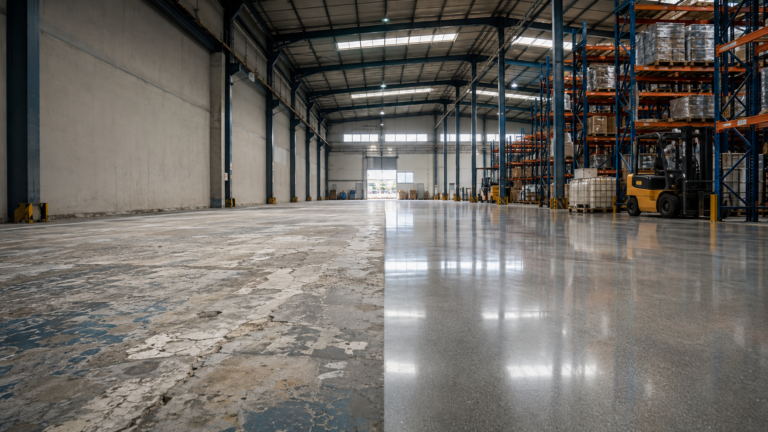
Why this question comes up so often in India right now
A large share of India’s industrial and warehousing real estate wasn’t built as Grade-A stock. It’s older mill buildings, converted godowns, and factory sheds — many built decades ago, before moisture barriers under the slab were standard practice, and often cured under site conditions that were far less controlled than what a modern laser-screed project would use today. As GST-era logistics consolidation and the e-commerce and 3PL boom push more operators into these older buildings (because they’re available, centrally located, and cheaper than new-build Grade-A space), the “can we just polish the existing floor” question comes up constantly — for old textile mill floors in Mumbai and Ahmedabad being converted to fulfilment space, decades-old factory floors in industrial belts like Bhiwandi, Faridabad, and Sriperumbudur, and godowns across nearly every logistics corridor in the country.
The answer matters more here than it might in a newer market, because Indian retrofit candidates tend to bring a specific set of challenges: variable original concrete quality, minimal or no under-slab moisture barrier, and — in coastal and high-humidity cities — a real risk of ongoing moisture vapor transmission that a drier climate wouldn’t create.
What is existing concrete floor polishing?
Existing concrete floor polishing — also called retrofit polishing — means taking an existing slab, often years or decades old and sometimes coated, cracked, or stained, and processing it through mechanical grinding and chemical densification to achieve a durable, glossy, dust-free finish, instead of pouring and finishing new concrete. It uses the same core process as new-build polishing (grinding, densifying, polishing), but starts with a diagnostic and preparation stage that new concrete doesn’t need.
The four tests that actually decide the answer
1. Is the slab structurally sound?
Polishing removes a thin surface layer of concrete and densifies what’s underneath — it doesn’t add strength or repair structural problems. A slab with active settlement cracking, significant delamination, or deep spalling isn’t a polishing candidate; it’s a repair or replacement candidate first. This is a common finding in older Indian industrial buildings where the original slab was poured without steel fiber or proper joint design, and decades of forklift and trolley traffic have taken a visible toll. A general visual and sounding survey (tapping the surface to listen for hollow “drummy” areas that indicate delamination) is usually the first step, and it’s the one that most reliably rules a floor out before any money is spent on grinding.
2. What’s on the surface right now?
Old industrial floors in India are rarely bare concrete. Most have something on them — epoxy coating from a previous fit-out, a sealer, paint, or years of oil and chemical staining ground into the surface. Each of these behaves differently under a grinder:
- Thin sealers and light coatings usually grind off cleanly as part of the standard prep pass.
- Epoxy and polyurethane coatings — common in floors that were previously fitted out for a different tenant or use — typically need to be fully removed before densification. The densifier is a penetrating chemical hardener that has to react with the concrete itself, and it can’t do that through an intact coating layer. Removal is usually done by more aggressive diamond grinding or shot blasting.
- Oil and chemical staining that has penetrated deep into the concrete may not fully grind out, and can leave visible discoloration even after polishing — worth setting expectations on before starting, rather than promising a uniform finish that deep contamination won’t allow.
3. Is moisture coming up from below? (This is the test Indian retrofits fail most often)
Excess moisture vapor rising through the slab from the ground below is one of the most common — and most invisible — reasons a retrofit goes wrong, and it’s a bigger risk in India than in many other markets. A large number of older Indian industrial slabs were poured directly on grade without a vapor barrier underneath, which was not standard practice at the time. Combine that with a high water table (common in coastal cities like Mumbai, Chennai, and Kochi) or a facility that floods seasonally during the monsoon, and the risk of ongoing moisture vapor transmission is real.
Excess moisture can prevent the densifier from curing properly and, in some cases, cause a polished finish to fail months after installation — sometimes showing up as a hazy or blotchy patch, or as efflorescence (a white, chalky mineral bloom) on the surface. A moisture vapor emission test, or at minimum a simpler qualitative check for smaller or lower-risk areas, is standard practice before committing to a full retrofit, and it’s worth treating as non-negotiable for any building without a known vapor barrier.
4. How much crack and joint repair does it need?
Old slabs accumulate hairline cracks, joint spalling, and patch repairs over the years — often from previous flooring installations being removed, or from decades of unmanaged shrinkage cracking that was never designed for in the original pour (a common gap in older Indian construction, before shrinkage-compensating additives and steel fiber became standard). Before densification, these need to be filled with a compatible repair mortar. This is normal and doesn’t disqualify a floor, but it does affect timeline and final appearance: repaired areas rarely polish to an identical sheen as the surrounding original concrete, especially if the repair mortar has a different aggregate or density than the original pour.
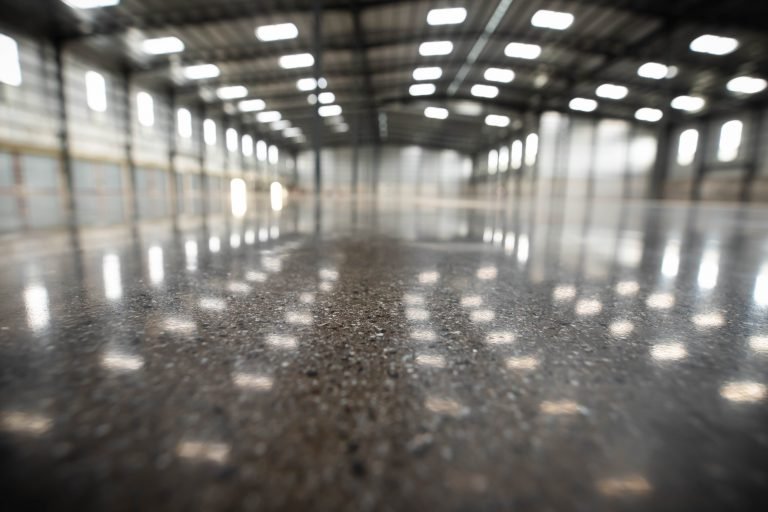
Retrofit candidate checklist
| Condition Found | What It Usually Means |
|---|---|
| Bare or lightly sealed concrete, no major cracking | Straightforward retrofit candidate |
| Full epoxy/PU coating present | Coating removal required before densification — added time and cost, but usually workable |
| Isolated hairline cracks, minor spalling | Repairable — expect slightly uneven sheen at repair points |
| Hollow/delaminated areas on sounding survey | Not a polishing candidate as-is — needs structural repair first |
| No known vapor barrier + high water table or monsoon flooding history | High risk of finish failure — needs a moisture mitigation step or a different flooring approach |
| Deep oil/chemical staining | Will polish, but may retain visible discoloration |
| Very thin or structurally weak topping slab | Grinding may expose aggregate unevenly or compromise the slab — evaluate case by case |
When retrofitting isn’t the right call
Not every old floor should be pushed toward a straight polish. Where moisture, structural condition, or contamination is severe enough — which, as covered above, is a genuinely common outcome for older Indian industrial buildings without a vapor barrier — a resurfacing overlay or a new microtopping laid over the prepared existing slab is often the more reliable and cost-effective route. It avoids fighting a substrate that was never going to polish evenly, and still delivers a durable, dust-free, densified finish on top.
The honest conversation to have with any contractor at this stage isn’t “can you polish this” — it’s “should this be polished, or is there a better way to get the same performance on this particular slab.” A contractor who only offers one answer to that question, regardless of what the diagnostic tests show, isn’t giving you the full picture.
Timing matters too: why monsoon season affects retrofit scheduling in India
Grinding and densification are moisture-sensitive processes, and high ambient humidity during India’s monsoon months can slow curing and affect how consistently a densifier reacts across the slab. For facilities in higher-humidity regions, or buildings with any history of water ingress, scheduling major retrofit work outside the peak monsoon window — or building in extra ventilation and drying time — is a practical consideration worth raising with your contractor at the planning stage, not after work has started.
What a proper retrofit process looks like, step by step
- Diagnostic survey — structural soundness, coating identification, moisture testing, crack mapping
- Coating and contamination removal, where applicable — aggressive grinding or shot blasting to expose sound concrete
- Crack and joint repair using compatible mortar systems
- Standard grinding sequence to prepare the surface and expose the desired aggregate level
- Densification — a penetrating hardener (typically a lithium silicate densifier) reacts with the free lime in the concrete to fill pores and voids, producing a harder, denser surface
- Diamond polishing to the target gloss level, followed by a final clean and seal as needed
Steps 4-6 are the same process used on new-build floors — our densification and polishing overview covers that stage in more depth. What makes a retrofit a retrofit is everything that happens before step 4.
Frequently Asked Questions
Can existing concrete floor polishing be done on any old slab? Not always. Existing concrete floor polishing works well on slabs that are structurally sound, free of major coating or contamination issues, and free of significant moisture vapor problems from below. A floor that fails these checks usually needs an overlay or new topping instead of a direct polish — see the checklist above for the specific conditions to look for.
Can a concrete floor with an epoxy coating be polished? Usually yes, but the epoxy coating has to be fully removed first — typically through aggressive diamond grinding or shot blasting — before the densifier is applied. The densifier needs direct contact with the concrete to react chemically with it, which an intact coating layer prevents.
Can cracked concrete be polished? Isolated hairline cracks and minor spalling can be repaired with compatible mortar and then polished, though repaired areas may not achieve an identical sheen to the surrounding original concrete. Structural cracking or delamination needs to be addressed separately before polishing is considered.
How do you know if an old concrete floor can be polished? A proper assessment checks four things: structural soundness (via a sounding survey for delamination), what’s currently on the surface (coatings, sealers, staining), moisture vapor emission from below the slab, and the extent of cracking or repair work needed. A floor that fails badly on any of these is usually better suited to an overlay than a direct polish.
Are old Indian warehouse and godown floors generally good candidates for polishing? It varies significantly. Many older Indian industrial buildings were built without an under-slab vapor barrier, which raises the risk of moisture-related finish failure, especially in coastal or high-water-table locations. A proper moisture and structural assessment is essential before committing to a retrofit on any building where the original construction details aren’t known.
Does the monsoon season affect concrete floor retrofit work in India? Yes. High ambient humidity during monsoon months can slow the curing and reaction time of densifiers, and buildings with any history of water ingress carry extra risk during this period. Scheduling major retrofit work outside peak monsoon season, or planning for additional ventilation and drying time, is a practical consideration for many parts of India.
Is polishing an old floor cheaper than pouring a new one? In most cases, yes — retrofitting an existing structurally sound slab avoids the cost and downtime of demolition and a new pour. However, floors requiring extensive coating removal, structural repair, or moisture mitigation can narrow that cost gap significantly, which is why a proper diagnostic assessment should happen before comparing costs.
Durafloor assesses and retrofits existing concrete floors for industrial, commercial, and warehouse facilities across India — including older mills, godowns, and factory buildings being converted for e-commerce, 3PL, and manufacturing use. If you’re evaluating whether an existing slab is a good candidate for polishing, talk to our team about a site assessment before committing to a scope.